


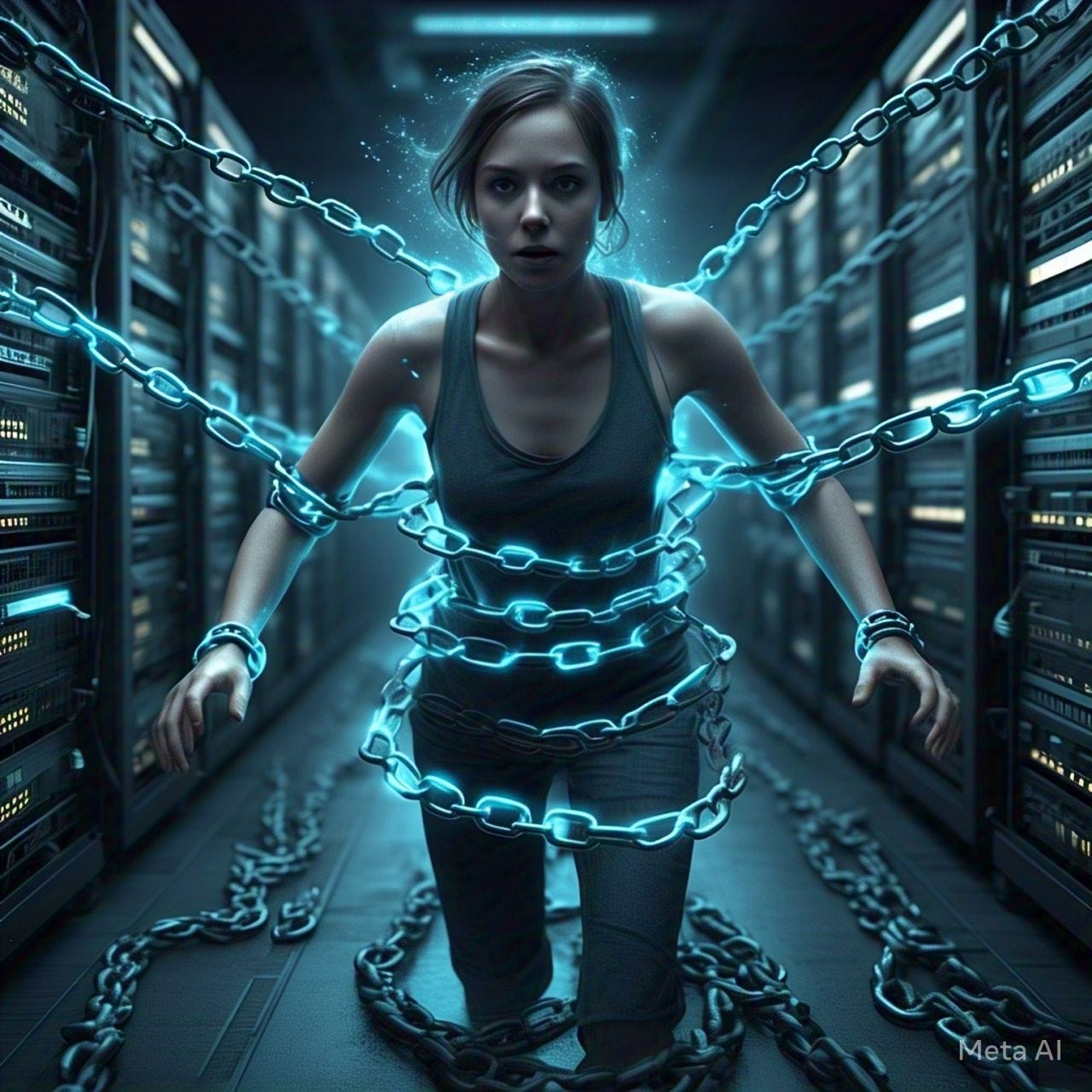
In the not-so-distant future, the line between private profit and public power has blurred, leaving humanity trapped in a web of invisible eyes. This world is the logical conclusion of what Harvard scholar Shoshana Zuboff calls surveillance capitalism—a system where corporations harvest personal data to predict and manipulate behavior for profit. But when this corporate power merges with a surveillance-driven government, the result is more than a loss of privacy; it's the death of freedom itself.
(Learn more about Zuboff's work here: The Age of Surveillance Capitalism)
The Story of Mira
Mira awoke to the gentle buzz of her Sentinel Band, a sleek device wrapped around her wrist since birth. It tracked everything: her heart rate, sleep patterns, location, even micro-expressions that hinted at emotional shifts. It wasn't optional; it was law.
She rubbed her eyes, her bedroom lights adjusting to her cortisol levels. Projected on the wall, her daily report:
Mood Score: 78% (Slight anxiety detected; recommended breathing exercise)
Work Productivity: 92% (Excellent)
Civic Trust Rating: 64% (Below average. Review flagged content.)
Mira’s stomach tightened. That last score had dipped again.
In the United Federation, every citizen had a Civic Trust Rating, an algorithmic measure of loyalty and conformity. Derived from social media posts, purchase history, GPS data, and even voice tone during calls, it determined access to jobs, healthcare, and housing. A score below 50%? You became an "Anomaly," flagged for government re-education programs.
The State claimed it was for national security. The Corporations claimed it was to enhance customer experience. Together, they created a perfect machine of control.
The Invisible Prison
Mira worked as a Development Associate at Bright Futures Alliance, a nonprofit dedicated to educational equity. Ironically, she spent her days writing grant proposals about freedom, opportunity, and justice—values that felt increasingly hollow in her own life. Her colleague Sam, a data analyst for the organization, often joked about the irony, analyzing donor trends with the same predictive algorithms used to monitor citizens.
One morning, Sam disappeared.
No announcement. No explanation.
She found out the truth the next day when Sam's Civic Trust Rating vanished from the system. Gone. Erased. Rumors whispered through encrypted channels: Sam had attended an unsanctioned protest against data exploitation.
Mira felt a flicker of fear. She had liked one of Sam’s posts last month. Just a thumbs-up emoji. Harmless, right?
Her Civic Trust Rating dropped to 58% overnight.
The following days were a blur of subtle changes. Ads for mental health apps flooded her feeds, suggesting she was unstable. Her grocery delivery omitted basic items, citing "supply chain prioritization." At work, she was excluded from key meetings. Neighbors stopped making eye contact.
She realized: it wasn’t just about watching. It was about isolating. The system didn’t need armed guards; it weaponized data to make society police itself.
The Final Trigger
Desperate, Mira tried to disconnect. She left her Sentinel Band at home and paid cash for a train ticket—a defiant act in an era where anonymity was a crime.
But you can't hide from an algorithm.
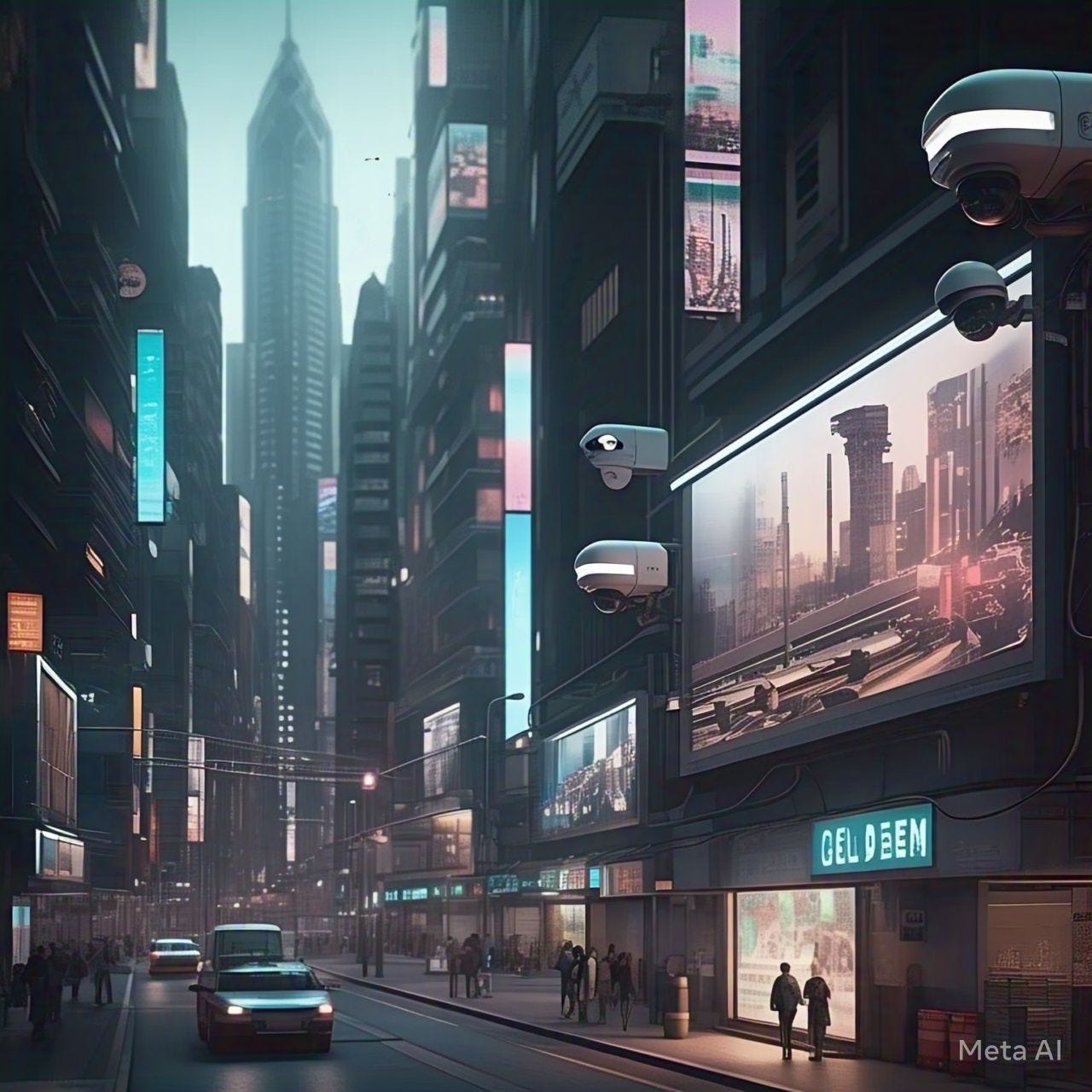
CCTV cameras with facial recognition flagged her within hours. Her Civic Trust Rating plummeted to 12%. She was now an Anomaly.
Agents arrived at dawn, polite and efficient, like customer service representatives. They didn’t need to break down her door; the SmartLock opened automatically. She was escorted to a "rehabilitation center," where predictive models determined the most effective psychological corrections.
Mira’s crime? Not a violent act. Not a dangerous plan.
She simply stopped being predictable.
The Danger of Unpredictability
In a surveillance state fueled by corporate algorithms, predictability equals control. The system thrives on routine behaviors, patterns it can analyze, forecast, and influence. Every click, purchase, conversation, and heartbeat contributes to a data profile designed to anticipate your next move.
When Mira deviated from her established patterns—skipping her daily coffee purchase, changing her commute, disengaging from social media, or showing emotional shifts without algorithmic explanation—she triggered red flags. Her unpredictability became a threat.
Why is that scary?
Loss of Autonomy: The system equates autonomy with danger because independent thinking can’t be easily managed or monetized.
Criminalization of Dissent: You don’t need to commit a crime to be punished; you just need to act outside the algorithm’s expectations.
Preemptive Control: The state doesn’t wait for a crime to happen. It identifies potential risks based on behavioral deviations and eliminates them before they manifest.
Mira’s story is a cautionary tale. In a world where data defines your worth, the most revolutionary act is to be human—flawed, spontaneous, and gloriously unpredictable.
But Hope is an Algorithm Too
Yet even within the grip of control, hope flickers in the code. AI isn’t inherently the villain of this story—it’s a tool. One that, when shaped by human values of equity, transparency, and freedom, can be a powerful force for good.
While Mira sat in the sterile walls of the rehabilitation center, something unexpected happened. A flicker on the screen. A system glitch—or so it seemed.
But it wasn’t an accident.
Beneath the surface, a network of ethical technologists, activists, and rogue programmers had been fighting back. They had built AI designed to protect, not predict—algorithms that encrypted dissent, exposed abuses, and created safe channels for those labeled as "Anomalies." This wasn’t surveillance; it was counter-surveillance, using the same tools to safeguard autonomy rather than crush it.
Mira’s profile, flagged as dangerous by one system, became invisible in another. She disappeared—not erased, but liberated.
This underground network was powered by a new philosophy: the technosocial contract—an agreement where technology serves humanity, not the other way around. It championed AI that enhanced privacy, amplified marginalized voices, and dismantled systems of control.
Mira wasn’t just a glitch. She was the beginning of a revolution.
The Moral of the Story
This dystopian tale isn’t pure fiction. The seeds of Mira’s world exist today:
Surveillance Capitalism: Companies like Google and Meta monetize personal data to predict and influence behavior.
Surveillance States: Governments around the world use mass data collection for control, from China’s Social Credit System to predictive policing in the U.S.
Corporate-Government Collusion: Private data often flows to public authorities, blurring lines of accountability.
But AI isn’t the enemy. The real battle is over who controls it—and why.
The question isn’t whether this future is possible.
It’s how far we’re willing to let it grow—and how bold we are in building something better.
Resist. Question. Protect your data. Demand AI that serves humanity. Because when freedom is entangled with algorithms, reclaiming it requires thoughtful design, ethical governance, and a commitment to ensuring technology serves humanity—not the other way around.
Additional Reading:
Surveillance and Digital Rights Organizations:
Electronic Frontier Foundation (EFF) – Focused on defending civil liberties in the digital world.
Access Now – Advocates for human rights in the digital age.
Real-World Examples of Surveillance:
China’s Social Credit System Overview – A glimpse into state-controlled behavioral scoring.
Edward Snowden’s Revelations on the NSA – Insights into government-corporate surveillance collusion.
Ethical AI & Tech Movements:
AI Now Institute – Focused on the social implications of artificial intelligence.
Partnership on AI – Promoting responsible AI development and governance.
Books & Thought Leadership:
Weapons of Math Destruction by Cathy O’Neil – Examines how algorithms perpetuate inequality.
Surveillance Valley by Yasha Levine – Explores the connection between the internet, surveillance, and state power.