


We’ve come a long way since the Mad Men era — a period of mid‑20th‑century corporate culture defined by swagger, suits, and sexist, exclusionary norms. Workplaces in the 1950s–1970s often lacked formal protections for women and people of color; sexual harassment wasn’t discussed, much less regulated. The TV show Mad Men dramatized that world — a world before clear harassment policies, before HR accountability, before norms that most working people today would consider basic.
We look back now with disbelief: How did people get away with that?
And yet, in many ways, today’s AI policies feel like that “before” picture again: templates with no teeth. Rules without muscle. Lip service without lived practice.
It’s not that we don’t know better. It’s that we haven’t decided to care.

Part I: Public Reckonings and the Policies That Follow
Sociologists refer to the concept as cultural lag — when institutions, laws, and ethics trail behind shifts in technology or social norms. We tend to codify only what we’ve already begun to reckon with. This helps explain why major policy change often comes after public discomfort, not before.
Take 1991. That was the year Anita Hill testified before the U.S. Senate Judiciary Committee, bringing workplace sexual harassment into national view for the first time. Her testimony, watched by 86% of Americans, became a cultural flashpoint and marked the beginning of real institutional response.
It was one of the first times workplace sexual harassment was discussed on a national stage. It was also a moment I paid attention to.
I was in fourth grade. For a current events project, I picked Anita Hill. I stood in front of my class with a manila folder, trying to pronounce words I didn’t fully understand. My mom helped me prepare — not by talking down to me, but by helping me understand what Hill was naming: power used inappropriately, and a woman’s right to say so. I don’t remember my teacher’s reaction. But I remember feeling like I was saying something real. That memory has stayed with me.
Change often demands someone naming the unspoken.
Hill’s testimony did not stop Thomas’s confirmation; he was confirmed as an Associate Justice by a narrow 52–48 vote. But her willingness to speak up changed the national conversation. It forced America to look at something it hadn’t looked at before.
Too many Americans didn’t even know that sexual harassment was illegal or actionable. Suddenly, they did. And the year after Hill’s testimony, the EEOC reported a 50% increase in federal and state harassment complaints (Ms. Magazine).
That moment — uncomfortable, televised, and unforgettable — became an inflection point. Workplaces began implementing harassment training. New protections emerged. Laws evolved. It was messy. And it moved culture.
Part II: From Recordkeeping to Integrity
We saw a similar shift with financial accountability. The early 2000s brought corporate scandals that rocked public trust — Enron, WorldCom, Tyco. These weren’t just business failures. They were ethical breaches. Falsified earnings, shredded documents, insiders cashing out.
Congress responded with the Sarbanes–Oxley Act of 2002, aimed at increasing corporate transparency and oversight. Though designed for public companies, the ripple effects reached nonprofits too. New expectations emerged: conflict of interest disclosures, whistleblower protections, board governance practices, and eventually audits and annual filings that served as more than just math.
The IRS overhauled Form 990, asking about governance, independence, and ethical practices. Foundations and nonprofits began implementing internal controls not just to balance books, but to reflect values.
It didn’t stop every scandal. But it created the tools and pressure points to surface wrongdoing. Suddenly, embezzlement wasn’t invisible. Transparency wasn’t optional. Accountability had a paper trail.
There’s something sobering about remembering that shift. I worked in technology and philanthropy during that time. I remember watching colleagues adapt. Sometimes reluctantly. But with recognition that what we were being asked to do wasn’t just bureaucratic.
Ethics became visible on spreadsheets.
Part III: Where AI Policy Stands Now
AI is changing how we work — from how we write, to how we hire, to how we award grants. It shapes how we interpret information and how we make decisions. And yet, in most organizations, AI policy lives in the shadows:
A clause buried in an employee handbook.
A vague acceptable use paragraph.
A prohibition against “AI-generated proposals,” with no explanation of why, or what’s considered “generated.”
According to Candid, 23% of funders reject AI-generated proposals outright, citing concerns over authenticity and transparency and yet few offer guidance on how they define or detect AI use.
Meanwhile, over two-thirds of nonprofits and foundations already use AI tools, but most lack a values-based framework to guide adoption CEP, 2025.
“Policy is not the same as practice. And compliance isn’t the same as conscience.”
This moment — like harassment before policy, like embezzlement before Sarbanes–Oxley — demands more than checkboxes. It demands moral clarity.
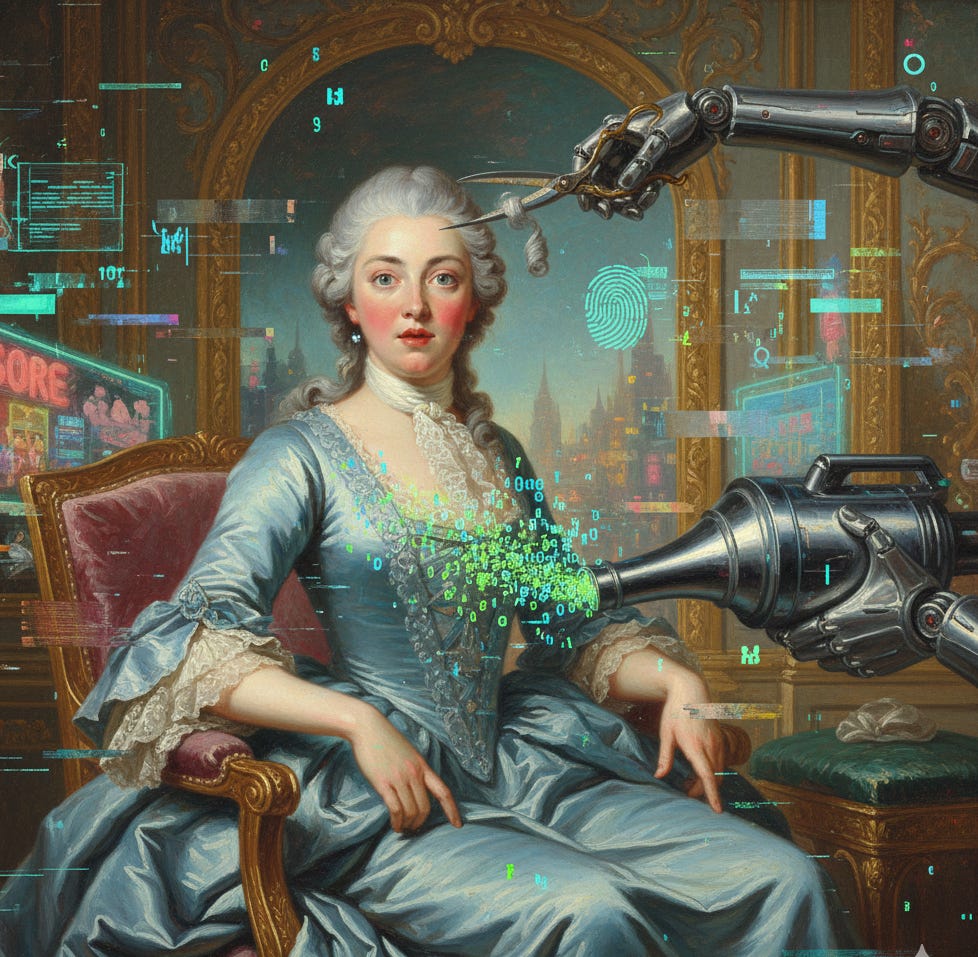
Much like physical harm, data harm is intimate and extractive. In The Rape of the Lock, Alexander Pope satirized aristocratic vanity: a stolen lock of hair becomes a symbol of violation. Today, we give away far more: our words, faces, behaviors, patterns — all of it quietly harvested, catalogued, and monetized.
“A lock of hair once shocked. Now we surrender our whole digital fingerprint.”
Consider TikTok’s 2026 privacy update. It expanded data collection to include AI prompts, location, identity, and behavioral signals — not as leaks, but as formal, permitted policy (Wired).
So we ask again: Are these policies protecting us, or are they protecting our comfort?
Because right now, we’re back in the Mad Men era of AI. We know something’s happening. But the policies haven’t caught up. The accountability doesn’t match the impact.
There are organizations doing great work. For example, the Rockefeller Foundation, which has launched initiatives exploring the internal use of AI led by the Culture Department (not IT), or Community Resource Exchange - NY, which builds digital resilience grounded in nonprofit values. But for the vast majority of funders and nonprofits, AI policy remains surface-level: drafted, filed, and rarely revisited.
And the people most affected — grantees, frontline staff, historically marginalized communities — are often the least consulted in shaping these rules.
Part IV: When Policy Becomes Practice
We’ve done this before. Not perfectly, but effectively.
With harassment, it took testimony, coverage, and public outcry before workplaces installed trainings and reporting processes. Even now, we’re still refining what prevention and response should look like.
With financial fraud, it took scandal and federal action to move the sector toward transparency and controls.
With AI, we have the luxury — and burden — of foresight. We can see its power. We can see its risk. We can choose to act before the harm.
But that won’t happen through templates alone.
A meaningful AI policy should be:
Relational, not just procedural.
Grounded in values, not just risk mitigation.
Contextualized by use case, not written in abstraction.
Created with the people who are affected, not handed down by the least affected.
And it must include support. CEP’s study found that 90% of foundations provide no financial or non-financial assistance to grantees navigating AI — even as nonprofits express interest in tools, training, and guidance (CEP, 2025).
This isn’t just a chance oversight. It’s a mirror.
Even the private sector is beginning to reckon with its responsibility. A recent McKinsey & Company article frames AI as a board-level priority, not just a tech consideration. Boards must define their “AI posture,” build fluency, and create governance structures that evolve with the technology (McKinsey, 2025).
Private philanthropy may not be the regulator but it has the resources, influence, and trust capital to lead these conversations. We are trendsetters in ethical tool use. When we invest in “tech for good,” we don’t just fund apps — we fund norms. That means showing how to govern tools with values baked in.
And if they are shifting? What excuse does philanthropy have to wait?
We are all called to be responsible. And in moments like these, philanthropy can prepare the soil so that new norms can take root across our sector and beyond.
Part V: Questions Worth Asking
So where does that leave us?
With AI shifting how we write, decide, and relate — are we really going to settle for boilerplate? For policy without pressure-testing? For trust without tension?
Or are we finally ready to treat this moment like the others we’ve lived through — the ones that felt uncomfortable until they became necessary?
What if AI governance isn’t just a tech issue, but a cultural test — asking what kind of stewards we’re willing to become, before the harm outpaces the policy?
And what if the question isn’t “Do we have a policy?”
but “Does our policy mean anything to the people who live under it?”
Because we know what living policies looks like.
We know what mutual accountability feels like.
And we’ve seen what happens when we get serious.
Author’s Note

All of these Substack pieces are written in partnership — me and ChatGPT, side by side on Saturday mornings (and Sunday night :) I do it because it’s fun. Because otherwise the dots just float before my eyes and never land. Because it turns out, with a dash of AI and a bit of intention, you can write clearly, personally — and more often.
Most weeks, the good phrases come in the shower, but Siri’s not listening. I wake up with stories in my head, but they vanish with the morning scramble — kids to the bus, snow boots to the door, cold air rushing in before coffee settles. Still, I write. Still, I open the laptop.
We live in Michigan now. It’s temporary — maybe. I still think of myself as New York–based, but that might change if we stay past this 12-month stint. I’ll be back in NY February 10–15 for my son’s birthday wish: ice skating with his old besties in Peekskill. If you’re nearby, meet me for lunch in the city or happy hour on the Hudson. We can thaw out together.
These weekly posts aren’t polished pronouncements — they’re practice. A streak I’m keeping. A thread I don’t want to drop. Writing, for me, is a way to hold on. To pay attention.
To say: I’m still here. And I still see the world a little differently — as a cognitive scientist, an ethical risk and compliance expert, and a futurist.
This is how I make sense of the noise. This is how I stay in the work.
This essay draws on a mix of academic research, sector analysis, and contemporary reporting to situate AI policy within longer histories of cultural change and institutional accountability.
References
Song, Z., Duan, Y., Wang, G., & Cheng, S. (2025). Artificial Intelligence and Social Well‑Being in the Yellow River Basin: A Cultural Lag Theory Perspective. Sustainability, 17(5), 2006. https://doi.org/10.3390/su17052006
Center for Effective Philanthropy. (2025). AI with Purpose: How Foundations and Nonprofits Are Thinking About and Using Artificial Intelligence.
https://cep.org/wp-content/uploads/2025/09/CEP_AI_Layout_FINAL.pdf
Candid. (2024). Philanthropy and Artificial Intelligence: Funders’ Policies and Practices. https://candid.org
Gallup. (1991). Senate Confirms Clarence Thomas to Supreme Court, 52–48. https://news.gallup.com
HISTORY. (2021). Anita Hill Testimony and the Clarence Thomas Supreme Court Confirmation Hearings.
https://www.history.com/news/anita-hill-clarence-thomas-hearings
Ms. Magazine. (1992). The Impact of Anita Hill: Reporting, Harassment Complaints, and Cultural Change. https://msmagazine.com
USC Annenberg Center for Public Relations. (2021). Anita Hill, Still Believing.
https://annenberg.usc.edu/research/center-public-relations/usc-annenberg-relevance-report/anita-hill-still-believing
McKinsey & Company. (2025). The AI Reckoning: How Boards Can Evolve.
https://www.mckinsey.com/capabilities/mckinsey-technology/our-insights/the-ai-reckoning-how-boards-can-evolve
Wired. (2024). TikTok’s New Privacy Policy Expands Data Collection to AI Prompts and Behavioral Signals.
https://www.wired.com/story/tiktok-new-privacy-policy/