


Article 4 → From Principle to Practice
Efficiency is the floor.
In nearly every boardroom I enter, AI conversations begin in the same place:
Can we automate reporting?
Can we summarize grant files?
Can we speed up diligence?
Automation feels modern. Speed feels responsible.
But efficiency is the weakest strategic use case in philanthropy.
2026 is not a moment for comfort. It is a moment for innovation — using every tool available with intention and structure.
Using the full toolbox requires more than experimentation. It requires structure.
Throughout this series, I’ve used the E4 framework — Efficient, Effective, Expansive, Equitable — as the ethical progression for AI adoption in philanthropy.
Most institutions stop at Efficient.
Very few design for Expansive.
Almost none anchor in Equitable.
And that’s where organizations get stuck.
A Familiar Moment
A foundation I worked with recently piloted AI transcription for hybrid board meetings.
The goal was simple: reduce note-taking burden and preserve institutional memory.
It seemed smart.
Within weeks, governance ambiguity surfaced:
Who owns the transcript? Where is it stored? Is it processed externally? Does summarization flatten dissent? Will board candor change if conversations are algorithmically mediated?
It was efficient.
But it wasn’t yet effective, expansive, or equitable.
Speed without structure just gets you to the wrong place faster.
We are in what I call the “computers landed on desks” moment. There was a time when organizations realized they didn’t really have a choice — they had to learn to use a computer. AI is now at that same inflection point. Cultural adoption is no longer optional.
Acceleration exposes thin governance.
What “Stuck” Actually Looks Like
Being stuck is rarely reckless.
It looks like fragmented experimentation across departments, staff quietly testing tools without policy clarity, IT drafting AI guidance in isolation, board curiosity without defined ownership, vendor demos before governance review, no shared articulation of purpose.
Across the sector, this pattern is visible. The Center for Effective Philanthropy has urged funders to actively shape responsible AI norms rather than passively adopt tools. Philanthropy’s role is not just operational — it is ethical in a rapidly shifting ecosystem. And if foundations want influence over the norms AI will embed, governance must be intentional now.
Curiosity without structure creates fragility.
Moving from stuck to strategic requires architecture — not more tools.
The Framework: From Stuck to Strategic
In my advisory work with executive teams and boards, we map a progression from fragmentation to strategic governance. It is not a procurement journey. It is a leadership maturity journey under acceleration.
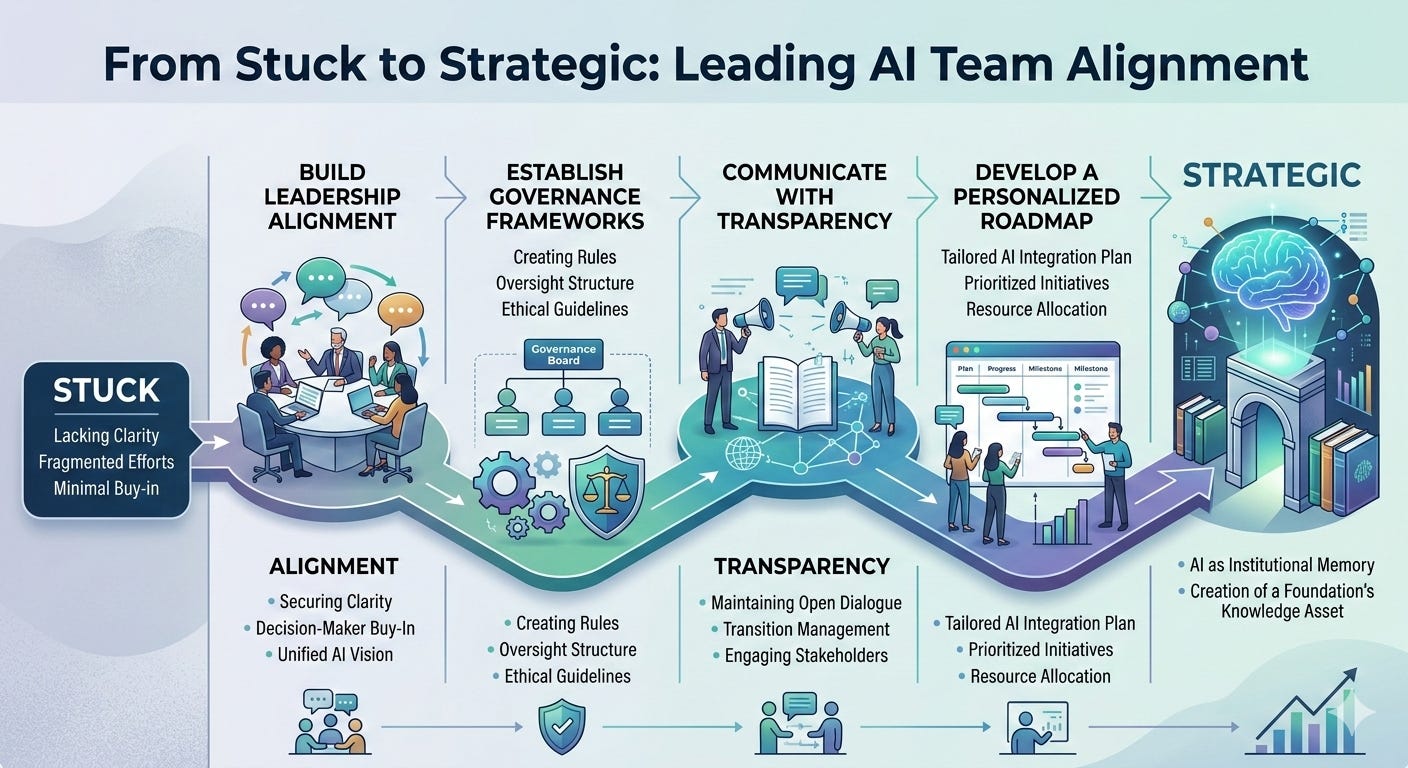
Organizations move through five shifts. Let me walk through each one.
1. Build Leadership Alignment
Strategic AI begins in governance — not procurement.
I learned this lesson most clearly while working with a public charity navigating the sunset of foundationConnect. On the surface, it looked like a technology replacement project: Salesforce or Blackbaud, which platform wins?
But the real conversation — the one that mattered — was never about the tools.
It was about what data we were collecting, from whom, for whom, and why. It was about which stakeholders were centered in our processes and which ones were invisible to our systems. It surfaced questions about power and accountability that a procurement decision alone could never answer.
That is what AI alignment looks like at its best. Not a vendor selection. A values interrogation.
Leadership must answer: Why does AI matter to our mission? What is our risk posture? What decisions are non-delegable? Are we optimizing for efficiency — or equity? How does AI intersect with our commitments?
If alignment centers on cost savings, use cases will follow. If alignment centers on learning, insight redistribution, and equitable decision-making, strategy shifts entirely — and so does every question you bring into a vendor conversation.
Alignment precedes adoption. Without it, experimentation becomes institutional drift.
2. Establish Governance Frameworks
Many leaders are governance-anxious. I remind them that the discipline already exists in their institutions — 990 audits, HR compliance, board fiduciary standards. These are the North Stars philanthropy has always navigated by. The same discipline must apply to AI.
Recently I reviewed two AI policies from philanthropic institutions — both thoughtful, both serious. But they were wildly different documents.
The first was built around efficiency. It focused on which tools were approved, how to use them safely, and where productivity gains could be realized. It was well-crafted. It would have been completely at home in a corporate compliance handbook.
The second was built around equity. It asked different questions entirely: Whose voice might be flattened by automated summarization? What does consent look like when AI processes community-generated data? Who has the right to opt out? How do we audit for bias before scaling?
Same sector. Same moment. Profoundly different frameworks — because the organizations had done fundamentally different alignment work first.
Governance is not about blocking innovation. It ensures that enablement does not run ahead of strategy.
Strategic governance includes explicit decision rights, oversight structures, vendor transparency standards, bias review checkpoints, escalation pathways, and a defined disclosure posture. Major foundations are already doing this work publicly — the MacArthur Foundation has published its AI policy as a field resource, explicitly inviting other organizations to learn from it. Rockefeller Foundation shared on a panel their emergent approach to innovation and alignment across departments led by the Culture team. That is what governance leadership looks like — not perfection, but transparency and shared learning.
3. Communicate with Transparency
Trust erodes when institutions cannot explain themselves.
Uncertainty is costly — operationally and reputationally. When staff don’t understand how AI tools are being used, or when communities sense opacity in how decisions are mediated, legitimacy erodes quietly before anyone notices it happening.
Transparency requires informing staff when AI is used in workflows, clarifying data processing practices, explaining when AI outputs influence decisions, and acknowledging limitations directly. In the same way oral and alternate reporting seeks to rebalance power in grantmaking relationships, AI governance must rebalance power in data relationships.
Opacity erodes trust. Clarity strengthens it.
4. Develop a Personalized Roadmap
No two foundations share the same data maturity, board literacy, compliance exposure, or cultural readiness. Generic playbooks fail — and the sector has no shortage of them.
One question I hear constantly: What about the environmental cost of AI? The energy consumption, the carbon footprint, the tension between using these tools and the climate commitments many foundations have made publicly.
Every time that question surfaces, we stop. We have to. There are no clean answers. Reconciling the tradeoffs requires research, honest review, and organizational discernment — and the organizations willing to do that work are the ones building governance that will actually hold.
That pause is not a problem. It is the work.
Governance maturity is measured by the questions you are willing to slow down for.
A strategic roadmap sequences that kind of discernment: prioritize use cases, define success beyond efficiency, align with mission and equity commitments, map vendor decision processes, build in 90-day implementation pathways that are realistic rather than aspirational.
Diagnostic precedes direction. Without assessment, scaling multiplies risk.
5. AI as Institutional Memory
This is where strategy compounds.
AI is not merely automation. Used well, it becomes institutional memory — funding pattern analysis across years, board decision continuity and synthesis, thematic insight across portfolios, grantee feedback aggregation at scale, knowledge retention during leadership transition, alignment audits between stated values and actual funding behavior.
This is not about faster emails.
Efficiency plateaus. Institutional intelligence scales.
The institutions that learn faster will govern better.
Resilience compounds. Memory compounds. Insight compounds. That is the strategic case — and it is a fundamentally different conversation than the one happening in most boardrooms right now.
Re-anchoring in E4
Efficient → Saves time
Effective → Improves outcomes
Expansive → Redistributes insight
Equitable → Shifts power
Most institutions stop at Efficient. Strategic institutions design toward Expansive and Equitable.
In philanthropy, where power and information asymmetry already exist, AI adoption without equity guardrails quietly reinforces existing imbalance. The Rockefeller Foundation’s AI for Development initiative (rockefellerfoundation.org/initiatives/ai-for-development) is one model for what centering equity in AI design looks like at scale — explicitly orienting toward underrepresented communities rather than optimizing for institutional convenience.
With governance maturity, AI can instead surface missed insights, strengthen learning loops, democratize access, and enhance accountability. But only if we stay in the driver’s seat. AI must not substitute for the relational intelligence that defines philanthropic trust.
E4 is not a slogan. It is a leadership discipline.
From Diagnostic to Direction
If you recognize your institution in the stuck column — fragmented experimentation, board curiosity without ownership, staff innovation without guardrails — you are not behind.
You are early.
But early without structure becomes risky. I’ve watched enough leadership teams move from curious to reactive to know the window for intentional design is shorter than it feels.
If you are the COO fielding AI questions from the board while staff experiment in the margins…
If you are carrying compliance exposure without a shared posture…
If you are expected to modernize operations without undermining mission…
You are already governing AI — whether the organization has named it or not.
That is why we are launching the AI, Governance & Operational Leadership Cohort through Full Circle Impact Solutions — designed for COOs, executive leaders, and board-facing operators navigating compliance risk, board expectations, operational modernization, and staff experimentation.
This is not AI training. It is expert-led governance architecture for institutions navigating real-time risk under AI acceleration.
Participants leave with mapped AI decision ownership, a defined disclosure posture, drafted guardrails, pressure-tested governance scenarios, a 90-day implementation pathway, and a private 60-minute strategy session to address organization-specific governance challenges.
Philanthropy seats underwrite nonprofit participation to ensure power-balanced learning.
Cohort capped at 8 leaders. By invitation and alignment conversation. Launch: April 2026.
If you are navigating this terrain without structured governance alignment, the risk is not hypothetical. Let’s design the posture before crisis forces it.
Let’s talk.
Align • Steward • Enable
Acceleration is here. Structure is optional. Leadership is not.
If E4 is our compass, governance is the infrastructure that allows philanthropy to move beyond speed — toward effectiveness, expansiveness, and equity.
That is how we move from stuck to strategic.
That is how AI amplifies mission — not fragility.
In the next piece: why AI governance risk is quietly consolidating at the COO level — and what it takes to align posture before crisis forces it.
Sources & Further Reading
MacArthur Foundation AI Policy — macfound.org/about/our-policies/artificial-intelligence
Rockefeller Foundation, AI for Development — rockefellerfoundation.org/initiatives/ai-for-development
Center for Effective Philanthropy, Responsible AI Guidance — https://cep.org/blog/responsible-ai-how-philanthropy-can-and-should-support-the-movement/
Kimber, R., Ehrlich, V., Vance, B., & Osei, A. (2025). Collective Learning in Philanthropy. The Foundation Review.
Kimber, R. & Vance, B. Purpose as a Compass: Grant Reporting — What is the Purpose? Linking Values, Vision, and Practice. Philanthropy New York.
Kimber, R. “From Stuck to Strategic: Leading AI Team Alignment.” Resilia Blog/Webinar Replay. December 4, 2025. — resilia.com
Kimber, R., Caplan, S., & Howell, J. “What Public Charity Grantmakers Can Teach Private Philanthropy.” PEAK Grantmaking and Submittable Webinar Transcript. January 2026. — peakgrantmaking.org