


At the beginning of this series, I asked you to get out of the dugout.
Stop waiting for the perfect AI policy. Stop waiting until we understand exactly where the technology is going. Start with the work. Experiment. Pay attention. Learn.

Over the last few months, we have been rounding the bases together. We started with alignment. We moved experiments into practice. We stopped asking simply whether AI was used and started asking harder questions about judgment, ownership, authority, and risk.
And somewhere along the way, I found myself returning to an idea I have been using with organizations for years:
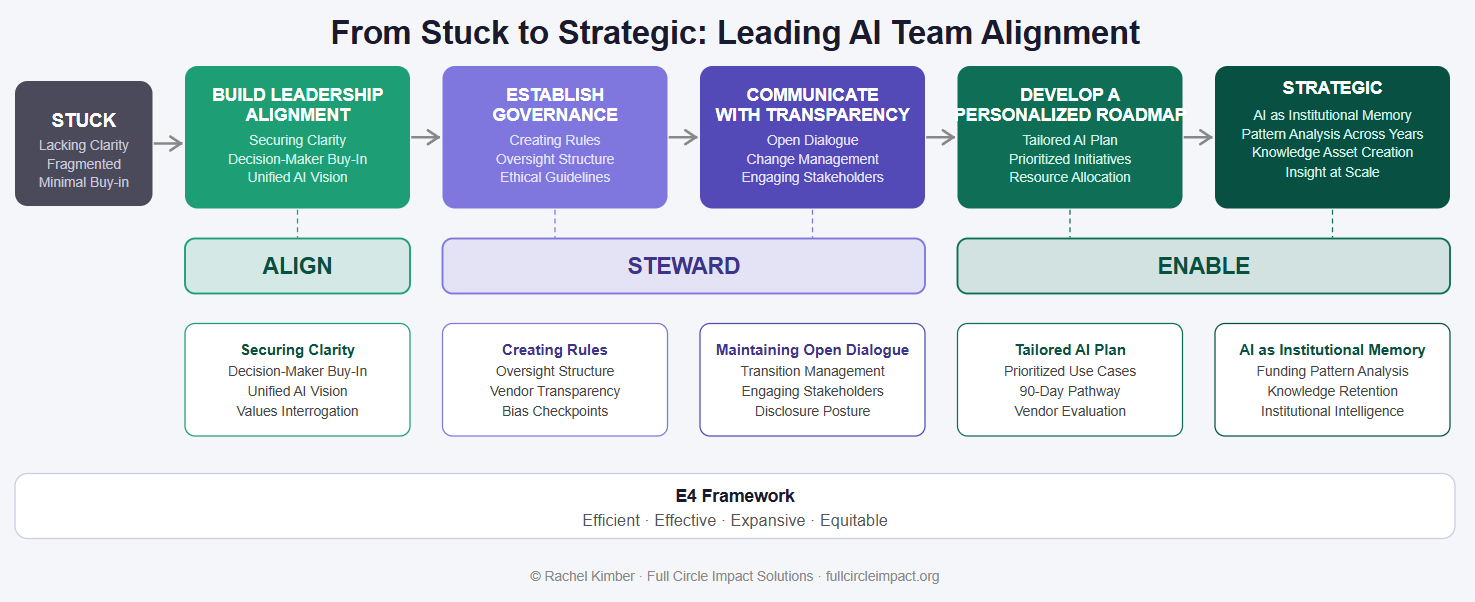
The only way from stuck to strategic is through.
Not around the uncertainty. Not by waiting it out. Through it.
What are we trying to build?
A few weeks ago, I changed the way I opened the second workshop in an AI governance series with NTEN.
I showed participants the goal first.
It was a practice guideline, what I have increasingly started calling a script.
The script is not an AI policy. It isn’t a list of approved tools. It is a plain-language description of how a particular piece of work happens when AI participates in it.
What is the work?
What is AI doing?
Where did judgment shift?
Who has authority?
What gets documented?
When (how!) do we stop it?
I showed them the script first because sometimes we need to see what we’re building before we can grapple with the journey required to build it.
And there is a reason I think this matters now.
We have had automation for years. An application is submitted and an email appears in someone’s inbox. A report is ready for review and the program officer gets a desktop notification.
But the systems coming into our organizations can increasingly do more than move information from one place to another. They can read, interpret, recommend, initiate and act.
Imagine a system that doesn’t simply notify a program officer that a report arrived. It reads the report, determines that information is missing, decides what clarification it needs, and sends the grantee a follow-up.
That is no longer simply a question of efficiency.
It is a question of judgment and authority.
Before we delegate more of our work to AI, we need to understand how that work is supposed to work.
This is not actually a new question for me
For most of my career, I have been asking some version of the same thing.
We collect all this data. We ask for all these reports. We build systems and dashboards and theories of change.
Are we learning anything? And are we doing anything differently because of what we learned?
Years ago, I was asking that question about grant reporting and data. Could reporting become something more than compliance? Could the information flowing between nonprofits and funders actually help us learn together?
That work led me toward oral and alternate reporting, emergent learning, shared sensemaking, and the idea that the people closest to the work hold knowledge our systems frequently fail to capture.
I eventually described the opportunity across three dimensions: efficiency, effectiveness, and expansiveness. Reduce unnecessary work. Use information more effectively. Then ask what becomes possible when information can actually support collective learning.
AI has not changed that question.
It has made it more urgent.
Because AI can now participate across the entire chain:
Data → learning → judgment → action → impact.
And the farther it travels along that chain, the more important it becomes for us to understand exactly what is happening.
From stuck to strategic, again
When I first started talking about moving organizations from stuck to strategic, I was trying to give people permission to move.
You do not need all the answers before you begin.
Start somewhere. Learn. Put some governance around what you’re learning. Document it. Reflect. Adjust.
That need to move through is showing up across the sector. NTEN and The Bridgespan Group’s new State of Nonprofit AI Adoption and Governance study found that nearly three-quarters of respondents who answered the question are already using AI at least weekly, including 45% who use it daily or more. But among executives surveyed, only 22% said their organization currently has a plan in place for managing AI-related risks, and just 22% said training on safe and responsible AI use is in place. The use is already happening. The organizational practice is catching up. That is the work between stuck and strategic.
Strategic was never supposed to mean finished.
It means an organization has developed enough clarity and capacity to learn its way through what comes next.
That is why the script matters to me.
A good practice guideline gives us something useful today. It documents a practice in language that a program officer, COO, grants manager, executive, board member, technologist, or auditor can understand.
But the artifact isn’t really the point.
The organizational muscle required to create it is.
To write the script, we have to understand the work. We have to surface assumptions. We have to identify where judgment happens. We have to decide what authority belongs to a person and what we are comfortable delegating to a system. We have to determine what evidence we need to retain and what would cause us to stop.
Those are AI governance questions today.
They are going to become much more important as AI becomes capable of doing more on our behalf.
The next inning
My work has always been about learning organizations.
Data and reporting. Data and impact. Now data and AI.
Learn. Reflect. Do better.
The technology will keep changing. I intend to stay a few steps ahead of it. That is part of my job.
But I don’t think every foundation or nonprofit needs to chase every model release, understand every technical development, or predict exactly what an agentic future will look like.
Organizations need something more durable.
They need to know how their work works.
They need to know what they value, where human judgment matters, what they are willing to delegate, and how they will know whether the work is actually getting better.
At the beginning of this series, I asked you to get out of the dugout.
So we did.
We rounded the bases.
And now we are coming home.
But home plate was never the destination.
It is where we take what we learned, and get ready for the next inning.
The only way there is through.
Ready to talk?
If your organization is trying to figure out what it is ready to hand to AI, and what should stay firmly with people, that’s the work I’m doing with foundations and nonprofits right now.
I work with COOs, executive leaders, boards, and grants management teams to build the practices, boundaries, and organizational competency responsible AI delegation requires. Not a policy nobody reads, but a clear Script for what AI can do, where people retain judgment, and what your organization isn’t ready to hand off yet.
About the Author
Rachel Kimber is managing director of Full Circle Impact Solutions, where she helps foundations and nonprofits build the infrastructure to use AI effectively, ethically, and in service of mission. She works with boards, leadership teams, and grants management staff to align technology adoption with institutional values.
She is faculty for PEAK Grantmaking’s Practical AI for Grants Management Learning Series and NTEN and TAG’s certification programs. Rachel created the Stuck to Strategic Framework and speaks internationally on AI, governance, and organizational strategy.