


We used to drive without seatbelts.
Not because people did not care about safety, but because risk had been normalized for so long that it stopped feeling like risk. It just felt like driving.
The nonprofit sector has done the same thing with technology.
For decades, we have accepted underfunded systems, fragmented data, undertrained staff, and technology decisions made without governance as the cost of doing mission work. We called it lean. We called it resourceful. We called it doing more with less.
It was not lean.
It was digital fragility.
And it has been building quietly underneath every program, every grant cycle, every staff transition, and every pivot to meet the next crisis long before this one arrived.
For years, nonprofits survived fragile infrastructure through improvisation, institutional memory, and very committed people willing to hold broken systems together with spreadsheets, workarounds, and sheer force of will. But AI, cybersecurity threats, political hostility, rising reporting complexity, and shrinking operational capacity have changed the scale and speed of the risk.
The old “make it work” model is breaking down.
The Crisis CEP Is Documenting Has a Missing Chapter
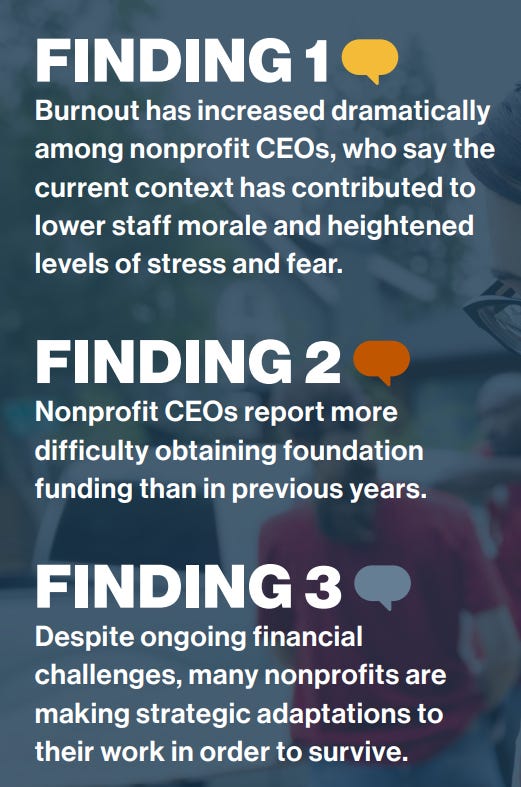
The Center for Effective Philanthropy’s recent data on the state of the nonprofit sector is stark. Sixty-nine percent of nonprofits reported funding cuts. Seventy-one percent are worried about financial stability. Forty-six percent say they may need to close or merge. Nearly a third have already reduced services.
These are not abstract numbers. These are organizations that exist because a community need was real and a group of people chose to show up for it.
And yet, in nearly every framework being used to diagnose this crisis, technology is still treated as a side condition. A back-office issue. A capacity add-on. Something to address once the “real” problems are stabilized.
That framing is wrong. Because this is not a technology problem.
It is a mission risk problem.
What Digital Fragility Actually Looks Like
Digital fragility is not about whether an organization has a website or uses cloud storage. It is the condition where an organization’s mission depends on technology, data, platforms, and digital workflows, but those systems are underfunded, poorly governed, insecure, fragmented, or held together by one or two exhausted staff members who know where everything lives and what to do when it breaks.
Often, those staff are operations professionals, grants managers, coordinators, program staff, or “the tech-savvy one” who somehow became responsible for fixing the printer, managing the CRM, onboarding new staff, troubleshooting Zoom, and explaining AI to leadership while still doing their actual job.
Their institutional memory becomes the infrastructure.
And when they burn out or leave, entire systems destabilize.
Digital fragility looks like:
A program director manually reconciling three spreadsheets, two portals, and a shared drive that has not been organized since 2019 because the CRM was never properly implemented.
A finance team using a system that cannot talk to the grants management platform, so someone spends hours a month copying numbers like it is a sacred ritual handed down through generations.
A community health organization storing immigration status, mental health history, and identity-based data in tools with no clear governance, no consent framework, and no one formally responsible for what happens to that information.
A leadership team that knows staff are using AI tools but has not issued guidance, provided training, or clarified expectations, so experimentation is happening quietly, inconsistently, and without accountability.
This is not a future risk.
This is Tuesday.
The Foundation World Sees It
Here is the part worth naming directly: this is not invisible.
Foundation leaders know nonprofits face digital and data security risks. They know cyber threats are rising. They know reporting systems are burdensome. They know staff capacity is stretched thin. They know AI is already entering workflows whether policy exists or not.
And yet, investment decisions have not meaningfully shifted.
Technology is still categorized as overhead. Digital capacity is still treated as an innovation conversation instead of an infrastructure conversation. AI is discussed at conferences as a future-facing strategy topic while nonprofit staff are already using it to summarize case notes, draft reports, clean donor lists, write board updates, and survive impossible workloads.
The sector is discussing the house fire while refusing to talk about the electrical system.
And the organizations most likely to lack stable digital infrastructure, smaller nonprofits, grassroots organizations, and many BIPOC-led groups, are also the organizations carrying the heaviest community need right now.
NTEN’s 2025 Equity Guide makes this point clearly: technology investments shape outcomes for both staff and programs. Technology is not back-office support.
It is mission infrastructure.
Six Ways This Gets Worse If We Keep Looking Away
The reporting burden gets automated on funders’ terms, not nonprofits’ terms.
As philanthropy adopts AI to process grant applications and program data, expectations for cleaner, faster, more granular reporting will grow. The organizations without the systems to respond will not be seen as under-resourced.
They will be seen as unprepared.
Small organizations fall further behind.
The organizations with integrated CRM, finance, and reporting systems will look more “grant ready.” The ones without, often the organizations closest to the communities philanthropy claims to prioritize, will appear operationally weak even when they are doing the most essential work.
Data risk becomes equity risk.
Grantee stories. Community health data. Immigration status. Identity-based information. These are flowing through tools right now without clear consent practices, governance structures, or staff training.
And when that data is exposed, the people harmed are not the funders.
They are the communities we serve.
Burnout becomes digital burnout.
Staff are not just overworked in the traditional sense. They are manually reconciling broken systems. Navigating duplicate forms, siloed dashboards, passwords, portals, and a growing stack of AI tools no one has formally approved.
That is not a workflow inconvenience.
It is operational exhaustion disguised as dedication.
AI adoption happens in the shadows.
When leadership avoids the conversation, whether out of discomfort, bandwidth, fear, or uncertainty, staff still experiment.
The result is not caution.
It is unmanaged risk.
Shadow AI is not safer than governed AI. It is just undocumented.
Funders misdiagnose capacity.
They see weak operations where the real issue is chronic underinvestment in digital infrastructure. They fund programs but not the systems that make programs sustainable.
And then they wonder why organizations cannot scale, cannot report, cannot retain staff, and cannot survive leadership transitions.
What Philanthropy Should Actually Fund
This is not a call for every nonprofit to build a full IT department.
It is a call for philanthropy to treat digital resilience the way it treats financial resilience: as a prerequisite for mission sustainability, not a bonus feature for organizations that can already afford it.
That means funding:
Cybersecurity assessments and secure systems
CRM and data infrastructure cleanup and integration
Staff training and AI literacy
Technology governance, not just tool adoption
Reporting redesign built around what nonprofits can realistically produce
Consent and responsible data-use practices
Internal digital leadership capacity
Multiyear, unrestricted operational technology support
Because this cannot be solved in a one-time innovation grant and a panel discussion about “the future of AI.”
The future is already here.
It is sitting in a shared drive named “FINAL_v2_USE_THIS_ONE.”
The Seatbelt Was Always There
We do not need to wait for the crash to admit the seatbelt was missing.
The sector is being asked to navigate funding volatility, rising community demand, political scrutiny, staff burnout, cybersecurity threats, and AI disruption simultaneously, with infrastructure that was never built for any of it.
Digital fragility is not a side issue in this crisis.
It is one of the reasons crisis becomes collapse.
If we are serious about sector resilience, if CEP’s data is a call to action and not just a moment of collective grief, then philanthropy has to stop treating technology as overhead and start treating it as what it has always been:
The operating system underneath everything we say we care about.
Rachel M. Kimber is the Managing Director of Full Circle Impact Solutions, a BIPOC-led, woman-owned consulting firm working at the intersection of technology, equity, and organizational effectiveness in the social sector.
Love the term Digital Fragility! Your reflections and thoughts really resonated with me!
"Digital capacity is still treated as an innovation conversation instead of an infrastructure conversation"
So true! This scenario really worsens when we start thinking about non profits across low and middle income countries!
High time we identify and encourage funders who are willing to fund the 'Tech Plumbing' cost of the impact sector! Which sounds boring but essential for keeping the house not under water!